Skywatching Highlights for This Week
This week offers some fantastic opportunities for skywatching! There's plenty to explore in the night sky. Here are some highlights to look out for:
The Moon and Planets:
Watch the bright Moon step past Mars, Castor, and Pollux on Sunday evening. They'll bunch up, creating a beautiful celestial alignment.
The waxing crescent Moon will pair up with Saturn and then Venus. This pairing will be visible on Tuesday and Wednesday.
The full moon spans two evenings, Tuesday and Wednesday, offering a great view.
The Pleiades and the Winter Hexagon:
On the night of the 5th, the Moon will occult some of the Pleiades, a beautiful open star cluster.
The Pleiades cluster, also known as M45 or the Seven Sisters, dazzles in this image captured by the Cassini spacecraft. This star cluster consists of hundreds of stars, some of which can be seen with the naked eye from Earth, forming a stunning grouping in the Taurus constellation.
This large asterism spans much of the February sky and includes some of the brightest stars. It's a great guide for finding other constellations.
Constellations and Stars:
The Andromeda Galaxy (M31) is located within the constellation of Andromeda. This is the closest spiral galaxy to our Milky Way and is visible to the naked eye on clear, dark nights.
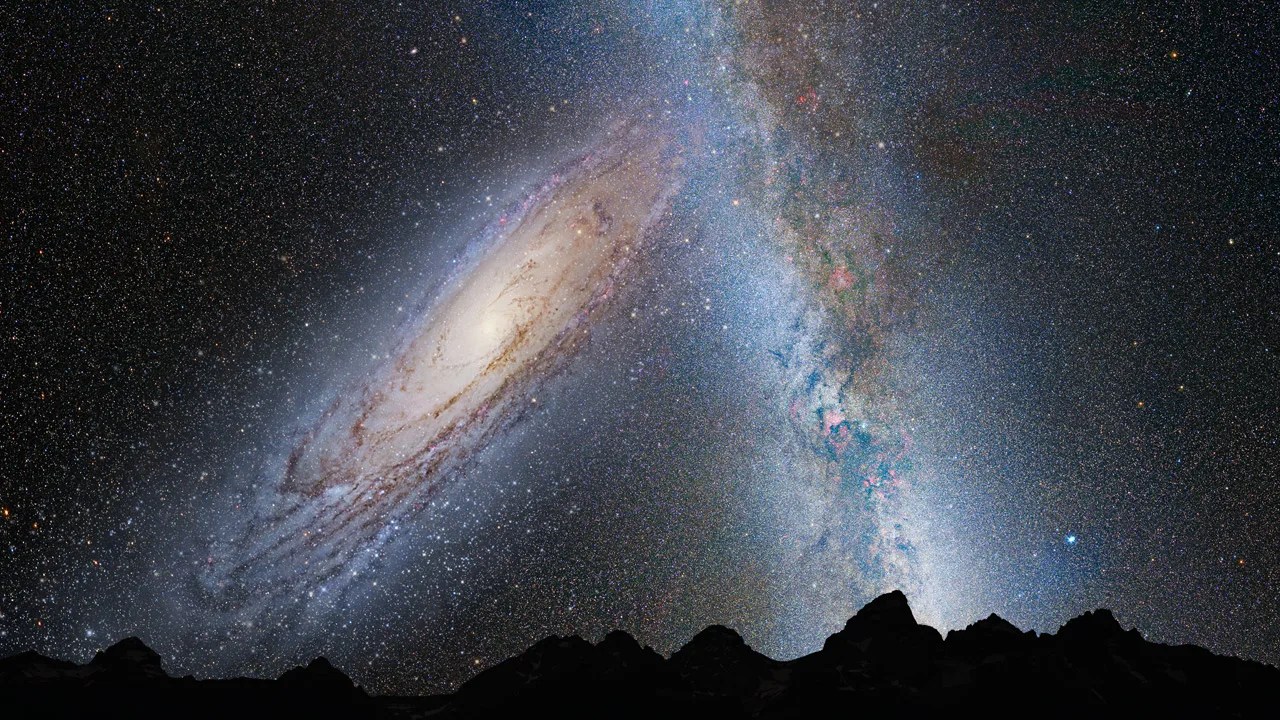
Andromeda, a stellar marvel this week, glows brilliantly in the night sky. This illustration captures a glimpse of a cosmic ballet, showing the anticipated merger between our Milky Way and Andromeda galaxies over the next several billion years. In this image, depicting Earth's sky 3.75 billion years from now, Andromeda (left) dominates the view, beginning to distort the Milky Way with its tidal pull.
The Double Cluster (h and χ Persei) is nestled between the constellations of Perseus and Cassiopeia. This stunning pair of open star clusters can be seen with the naked eye or through binoculars.
Algol (Beta Persei), known as the Demon Star, is a famous variable star in the constellation of Perseus. It changes brightness every few days, making it an interesting target for observation.
M15 (Great Pegasus Cluster) is one of the oldest known star clusters and is a beautiful object to observe through a telescope this week.
The W of Cassiopeia, the distinct W-shaped asterism, is easily recognizable and serves as a guide to finding other constellations in the winter sky.
Equipment Recommendations:
To enhance your stargazing experience, consider using:
Binoculars: Great for spotting Venus, Jupiter, and Mars.
Telescope: For a closer look at Mercury and Saturn.
Star Charts: Useful for navigating the night sky and finding specific celestial objects.
Bundle up, grab your star charts and telescopes, and immerse yourself in the wonders of the night sky. Happy stargazing!


Comments
Post a Comment